

Vehicle data recorders, dash cams, and AI crash reconstruction are reshaping how car accidents are investigated in Denver, giving attorneys and investigators new tools to determine fault and support injury claims.
Traffic accidents continue to be a significant public safety concern in cities across the United States, and Denver is no exception. As the population along Colorado’s Front Range continues to grow, the region has seen increased traffic congestion, heavier commuter corridors, and greater pressure on local roadways. With more vehicles sharing the same highways and city streets, the likelihood of collisions has risen too.
According to the Colorado Department of Transportation, thousands of crashes occur in the Denver metropolitan area each year, many of which result in significant injuries and financial losses for drivers and passengers. While the number of accidents remains substantial, the way those accidents are investigated and analyzed has changed dramatically in recent years.
Technology has become one of the most important developments in modern accident investigations. Vehicles now contain sophisticated electronic systems capable of recording detailed driving information. Cameras placed inside vehicles or along roadways capture footage that can document driver behavior and traffic conditions.
Advanced computer modeling and artificial intelligence tools allow investigators to reconstruct collisions with a level of precision that was difficult to achieve in the past. For individuals pursuing legal claims after a crash, these tools are increasingly central to how evidence is collected and analyzed.
Denver Personal Injury Lawyers frequently rely on digital evidence to clarify fault, demonstrate negligence, and support compensation claims.
Event Data Recorders Provide Objective Crash Information
One of the most significant technological developments affecting accident investigations is the widespread use of event data recorders in modern vehicles. Event data recorders, commonly referred to as EDRs, are electronic devices that capture information about a vehicle’s performance during a crash or near-crash event.
According to the National Highway Traffic Safety Administration, EDR systems can record information such as vehicle speed, engine throttle position, braking activity, steering input, and seat belt use during the seconds immediately before and after a collision.
Federal safety regulations establish standardized requirements for these systems under Title 49 of the Code of Federal Regulations, Part 563. These rules ensure that data stored by event data recorders can be retrieved in a consistent format by investigators and accident reconstruction specialists. Because the information is recorded electronically, it can provide objective insight into the mechanical and driver-related factors involved in a crash.
EDR data often becomes especially important when drivers provide conflicting descriptions of what occurred. For example, one driver may claim they slowed down before the crash, while another may argue the vehicle was traveling at excessive speed.
Event data recorder information may reveal whether braking occurred, how quickly the vehicle was traveling, and how rapidly the crash forces developed. Engineers and reconstruction specialists analyze this information alongside physical crash evidence to determine the most likely sequence of events.
For accident victims seeking legal compensation, this type of digital evidence can help strengthen a claim by providing measurable information about vehicle behavior leading up to the collision. As a result, Denver personal injury lawyers often work with technical experts who are trained to extract and interpret EDR data from damaged vehicles.
Dash Cameras Offer Visual Documentation of Accidents
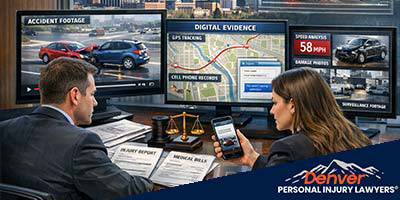
Another technology that has significantly influenced accident investigations is the dash camera. Dash cameras are compact recording devices mounted inside vehicles that capture video of the roadway while the vehicle is in motion. In many cases, the cameras continuously record traffic conditions and store footage that can be reviewed if an accident occurs.
Dash camera recordings can provide clear visual documentation of how a collision unfolded. Video footage may show traffic signals, lane changes, vehicle movements, and the actions of other drivers immediately before the crash. This visual record can be extremely valuable when there are disputes regarding fault or when witnesses provide inconsistent statements.
Colorado courts generally allow dash camera footage to be used as evidence when it satisfies legal standards related to authenticity and relevance. Insurance companies also frequently review dash camera recordings when evaluating accident claims because the footage can help determine how the collision occurred.
Dash cameras can reveal details that are often difficult to establish through testimony alone. For example, video evidence may demonstrate that a driver failed to yield the right-of-way, entered an intersection against a red light, or made unsafe lane changes. These recordings can also show road conditions such as weather, traffic congestion, or construction zones that may have contributed to the crash. For a Denver car accident attorney reviewing a claim, dash camera footage can serve as a critical piece of evidence that clarifies the sequence of events leading up to the collision.
Artificial Intelligence Is Enhancing Accident Reconstruction
Accident reconstruction has long been used to analyze complex collisions, particularly when serious injuries or multiple vehicles are involved. Traditionally, reconstruction specialists relied on physical evidence such as skid marks, debris fields, vehicle damage patterns, and roadway measurements to estimate speeds and vehicle movements. While these methods remain important, modern technology is improving the accuracy and efficiency of crash analysis.
Artificial intelligence tools are now being developed to assist investigators in evaluating accident data. Researchers have created AI models capable of analyzing large crash datasets and identifying patterns that help explain how collisions occur.
These systems can combine information from crash reports, vehicle data recorders, and scene measurements to generate digital simulations that illustrate the dynamics of a crash. Simulations allow investigators to recreate the positions and movements of vehicles before and during the collision.
The visual models can demonstrate how driver actions, vehicle speeds, and roadway conditions contributed to the accident. In legal proceedings, digital reconstructions can make complex accident scenarios easier for judges, juries, and insurance professionals to understand.
As these technologies continue to improve, accident reconstruction is becoming increasingly data-driven. Digital modeling and AI-assisted analysis allow investigators to evaluate multiple possible scenarios and determine which explanation is most consistent with the available evidence.
Digital Evidence Sources Continue to Expand
Modern accident investigations frequently involve several forms of digital evidence beyond the vehicles themselves. Surveillance cameras located near intersections or businesses sometimes capture footage of collisions.
Traffic monitoring systems operated by local transportation agencies may record roadway activity that helps document the moments leading up to a crash. In addition, smartphones carried by drivers or witnesses may contain photographs or videos taken at the scene.
When investigators combine these different sources of evidence, they can construct a comprehensive timeline of events surrounding the crash. Video recordings may reveal vehicle positions and driver behavior, while event data recorders provide technical measurements of speed and braking. Police crash reports, witness statements, and reconstruction models contribute additional information that helps investigators determine how the accident occurred.
For individuals pursuing legal claims, this combination of evidence can provide a more complete picture of liability and damages. Denver personal injury lawyers often work with investigators who collect and analyze these various forms of digital evidence to strengthen the factual foundation of a case.
Digital Evidence Must Be Preserved Promptly
Although digital evidence can be extremely valuable in accident investigations, it may not remain available indefinitely. Many dash cameras automatically overwrite older recordings once storage capacity is reached. If the footage is not preserved soon after the crash, the recording may be permanently erased. Event data recorder information may also be lost if the vehicle is repaired, destroyed, or otherwise altered before investigators retrieve the data.
Because of these risks, evidence preservation is an important step in accident investigations. Attorneys and investigators often act quickly to secure available video footage, request surveillance recordings from nearby businesses, and arrange inspections of damaged vehicles to retrieve electronic data.
Individuals involved in serious collisions may not immediately think about preserving digital evidence while they are dealing with injuries and medical care. However, acting quickly can help protect information that may later play an important role in determining fault and liability. A Denver car accident attorney may assist in identifying potential sources of digital evidence and ensuring that relevant records are preserved.
Technology Is Influencing Insurance Investigations

Insurance companies are also adapting their investigative practices to account for the increasing role of digital evidence. Adjusters frequently review dash camera footage, vehicle data recorder information, and police crash reports when evaluating accident claims. In cases involving significant damage or injuries, insurers may also consult accident reconstruction specialists who use modern modeling tools to analyze the collision.
The presence of detailed digital evidence can make it easier to determine responsibility for the crash, but it can also introduce technical complexities. Interpreting vehicle data and digital recordings often requires expertise in engineering, data analysis, and crash reconstruction techniques. As a result, accident investigations may involve technical experts in addition to legal professionals and insurance representatives.
Technology Is Changing How Accident Claims Are Proven
The continued development of vehicle technology and connected infrastructure suggests that digital evidence will play an even larger role in accident investigations in the future. Modern vehicles are increasingly equipped with advanced driver assistance systems that rely on sensors and cameras to monitor road conditions. These systems generate additional data about vehicle performance that may become relevant during accident analysis.
Transportation agencies are also expanding the use of traffic monitoring systems and connected vehicle technologies designed to improve roadway safety. The Federal Highway Administration has encouraged research into vehicle-to-infrastructure communication systems that allow cars and traffic systems to exchange information. As these technologies become more widespread, accident investigations may involve even more data sources than they do today.
For drivers involved in collisions, the growing presence of digital evidence means that the process of proving how an accident occurred is becoming increasingly technical. Denver personal injury lawyers and accident reconstruction specialists now work with a combination of vehicle data, video recordings, and digital modeling tools to establish the facts of a case.
Sources
National Highway Traffic Safety Administration, Event Data Recorders, https://www.nhtsa.gov/road-safety/event-data-recorders
Code of Federal Regulations, Event Data Recorders Final Rule (49 CFR Part 563), https://www.ecfr.gov/current/title-49/subtitle-B/chapter-V/part-563
Colorado Department of Transportation, Traffic Safety and Crash Data, https://www.codot.gov/safety/traffic-safety/data-analysis
Federal Highway Administration, Connected Vehicle Research Program, https://highways.dot.gov/research/research-programs/operations/connected-vehicle-research
National Highway Traffic Safety Administration, Traffic Safety Facts Annual Report https://crashstats.nhtsa.dot.gov
Cornell University, Research on AI assisted crash reconstruction models, https://arxiv.org/abs/2511.10853
This Article Was Brought to You by Denver Personal Injury Lawyers®
If you’ve been injured in a car accident or any other type of incident, don’t navigate the complex legal process alone. We offer free consultations to discuss your case with no obligation. Our dedicated team has recovered over $250 million for accident victims just like you, and we treat every client like family, providing compassionate, personalized support every step of the way.
We’re proud to have been recently honored as the Westword Best of Denver 2025 Readers’ Choice winner for Best Personal Injury Attorney and the ColoradoBiz Best of Colorado 2025 Readers’ Choice for Best Personal Injury Law Firm.
Contact us today at 720-500-4878 or visit denverlaw.com to get the help you deserve. Your recovery is our priority.
| Denver Personal Injury Lawyers® 1001 Bannock St #8 Denver, CO 80204 | Denver Personal Injury Lawyers® | Arvada Office 5610 Ward Rd #300 Arvada, CO 80002 |
| Denver Personal Injury Lawyers® | Aurora Office 3190 S Vaughn Way St #550 Aurora, CO 80014 | Denver Personal Injury Lawyers® | Boulder Office 4845 Pearl E Cir, Suite 101 Boulder, CO 80301 |
| Denver Personal Injury Lawyers® | Centennial Office 9200 E Mineral Ave #100 Centennial, CO 80112 | Denver Personal Injury Lawyers® | Lakewood Office 355 S Teller St #200 Lakewood, CO 80226 |
| Colorado Springs Personal Injury Lawyers® 102 S Tejon St., Suite 1100 Colorado Springs, CO 80903 719-888-4878 | Colorado Springs Personal Injury Lawyers® | Pueblo Office 323 S Union Ave, Suite B Pueblo, CO 81003 |