

Every August, Colorado’s roads change. School zones activate. Drop-off lines form. Crosswalks that sat empty all summer fill with children on foot and on bikes. And drivers who spent three months navigating I-70 and mountain highways suddenly have to share neighborhood streets with kids who are not always predictable, not always visible, and not always where a driver expects them to be.
The data on what happens next is not reassuring.
The Numbers Behind Back-to-School Season
According to NHTSA’s 2023 Children data report, 63% of child pedestrian fatalities in traffic crashes occurred during weekday crashes, defined as 6 a.m. Monday through 5:59 p.m. Friday, timing that corresponds directly with school schedules. In 2023, 171 children were killed as pedestrians in traffic crashes, representing 17% of all child traffic fatalities that year.
The deadliest hour of the school day is not the morning rush. The same NHTSA report found that among school-age pedestrians, more fatalities occurred between 3 p.m. and 3:59 p.m. than during any other hour of the day, the window when children stream out of schools across Denver, Aurora, Wheat Ridge, and Greeley. That is when the risk is highest and when many drivers are the least prepared for it.
NHTSA pedestrian fatality data shows that 77% of all pedestrian fatalities in 2023 occurred in the dark. As August gives way to September and October and Colorado’s days shorten, the early morning and late afternoon travel windows that school schedules create increasingly fall in low-light conditions. The risk does not peak in August and fade. It builds through the fall.
What Colorado Law Requires in School Zones
Colorado law treats school zones differently from ordinary roads, and intentionally so.
Under C.R.S. 42-4-615, any person who commits a moving traffic violation in a school zone faces increased penalties and surcharges on top of standard fines. The statute is explicit: school zones are enhanced enforcement areas where ordinary traffic violations carry a heavier legal and financial consequence.
Speed limits in school zones are typically set between 15 and 25 mph under C.R.S. 42-4-1101, with local governments authorized to establish the specific limit based on conditions around each school. In Denver, where the citywide residential speed limit dropped to 20 mph, school zone limits go lower. According to FOX31, enforcement in a school zone can result in a citation with fines doubled due to the enhanced safety zone designation.
Under Colorado’s speed limit statute, driving 25 mph or more over a posted limit is a Class 2 misdemeanor traffic offense. In a school zone where the posted limit is 20 mph, a driver traveling at 45 mph is not just reckless: they face potential misdemeanor exposure on top of civil liability for any injury that results.
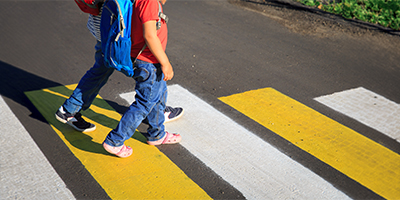
Colorado law also requires drivers to yield the right of way to pedestrians in crosswalks. Under C.R.S. 42-4-802, a driver must stop and remain stopped for a pedestrian crossing in a crosswalk when the pedestrian is on the driver’s half of the roadway or close enough to be in danger. This duty applies at every crosswalk, marked or unmarked. It does not require a flashing sign or a school zone designation to be in effect.
The Drop-Off Zone Problem
Most school zone injuries do not happen in the middle of the school day. They happen at arrival and dismissal, in the chaotic fifteen-minute windows when hundreds of vehicles and dozens of children converge on the same block at the same time.
Drop-off and pick-up zones are the most dangerous environment a child navigates every school day. Drivers are distracted, running late, and competing for limited space. Children move unpredictably, darting between cars, chasing friends, looking at phones. The physical geometry of a school drop-off creates dozens of blind spots: large SUVs blocking drivers’ views of children stepping into the lane, double-parked cars forcing children to cross between vehicles rather than at the designated crosswalk, and moving vehicles passing in the same lane where children are loading and unloading.
CDOT consistently identifies driver inattention and distracted driving as primary contributors to school zone crashes. The CDOT Speed Enforcement Program specifically targets school zones and other high-risk corridors because data shows that reducing speed in these areas directly reduces the severity of injuries when crashes occur.
The physics are not complicated. A child struck by a vehicle traveling at 20 mph has a meaningfully higher chance of surviving than one struck at 35 mph. The legal speed limit in a school zone exists precisely because that difference matters.
When a Child Is Injured: What Parents Need to Know
When a child is hurt in a school zone or near a school, the immediate response is medical. Everything else follows. But what follows matters, and the decisions made in the days after an injury can significantly affect a family’s ability to recover compensation for what happened.
Colorado’s three-year statute of limitations under C.R.S. 13-80-101 generally applies to personal injury claims. However, claims involving minor children have different tolling rules: in Colorado, the statute of limitations for a minor’s personal injury claim typically does not begin to run until the child turns 18. That does not mean waiting is safe. Evidence disappears on its own timeline, entirely indifferent to a child’s age.
If a government entity is involved, such as a school district vehicle, a city bus, a poorly designed crosswalk, or missing or inadequate signage near a school, the Colorado Governmental Immunity Act requires written notice of a claim within 182 days of the injury. That deadline applies regardless of the child’s age and does not toll for minors. Missing it can permanently bar a claim against the government entity, even when the child’s other claims remain viable.
Surveillance footage is time-sensitive in school zone cases just as in any other crash. Schools, nearby businesses, and traffic cameras along school corridors typically overwrite footage within days. A vehicle dashcam recording from a witness’s car can be gone by the next morning if that driver does not know to preserve it. Preservation demands must go out immediately, not after the family has had time to process what happened.
The at-fault driver’s insurance company opens a file the same day. Parents who wait weeks or months to consult an attorney are often negotiating against a claims adjuster who has already built a file, interviewed witnesses, and received a recorded account of the incident from their insured. That asymmetry is not unavoidable, but closing it requires moving quickly.
When the School or School District May Be Liable
Driver negligence is the most common cause of school zone injuries, but it is not always the only source of liability. In some cases, the school or school district may bear its own responsibility for the conditions that led to a child’s injury.
A school that directs students to cross at an uncontrolled location, that fails to maintain a crossing guard program required by district policy, or that creates a drop-off configuration that forces children into the path of traffic has made decisions that affect the safety of every child who arrives on foot. When those decisions contribute to an injury, the analysis extends beyond the driver’s negligence.
Government entity liability in Colorado is governed by the Governmental Immunity Act, and the notice requirements are strict. The 182-day window applies regardless of how the claim is framed. Any family considering a claim that might involve a school district or municipality needs legal advice quickly, not because the case is urgent in an emotional sense, but because the procedural deadlines are unforgiving.
What Bowman Law Handles
Bowman Law, LLC represents injured Coloradans and their families in pedestrian accidents, bicycle accidents, car accidents, and wrongful death cases across the Front Range, including cases involving children injured in school zones and school-related traffic incidents. The firm works on a contingency basis, meaning no fee unless compensation is recovered.
If your child was hurt near a school, in a drop-off zone, or in a crosswalk anywhere in Colorado, contact Bowman Law at 720-863-6904 or request a free consultation before evidence disappears and deadlines approach.
Back to school should not mean back to danger. When it does, families deserve to know their options.
Sources: NHTSA School-Transportation-Related Traffic Crashes 2014-2023 | NHTSA 2023 Children Traffic Safety Data | C.R.S. 42-4-615, School Zone Penalties | C.R.S. 42-4-1101, Speed Limits | C.R.S. 42-4-802, Pedestrian Right of Way | CDOT Speed Enforcement Program | CDOT Speed Limits | FOX31 School Zone Enforcement | C.R.S. 13-80-101, Statute of Limitations | C.R.S. 24-10-101, Governmental Immunity Act